Interview:
A Splash and a Stain Parts I & II
A Splash and a Stain Parts I & II
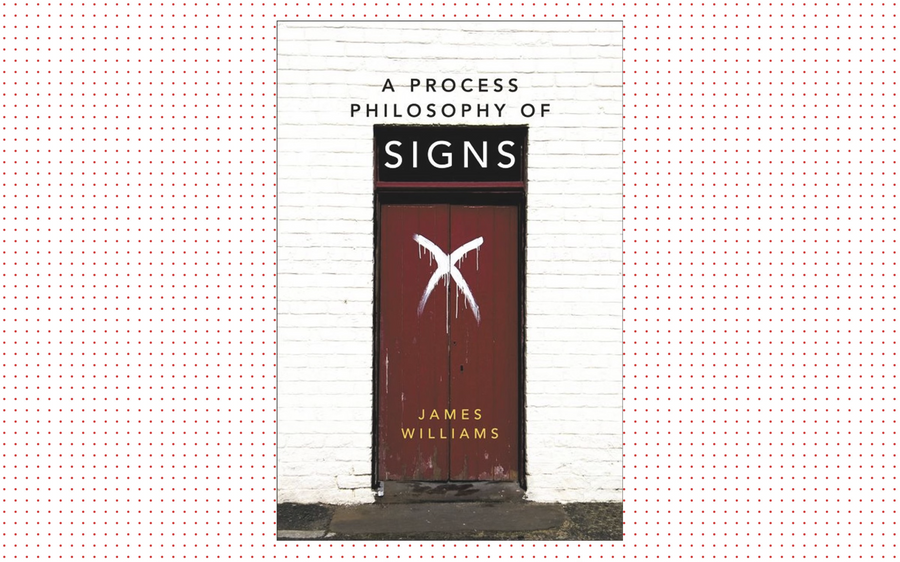
This year marks the tenth anniversary of James Williams’ A Process Philosophy of Signs. It is probably one of the most thought-provoking and insightful books of the past decade still unread by the design community at large. To be frank, it likely remains shelved in obscurity because of its unusual and at times finickity vocabulary; it takes some legwork to manoeuvre Williams’ ideas somewhere more familiarly design-specific but not so much (see below). Off the page, Williams is impressively lucid, down to earth, and very patient. In 2020 I spoke with him for hours about his thoughts on signs and processes in a way that turned them to more directly face design. The interview was published in two parts as A Splash and A Stain in Graphic Events: A Realist Account of Graphic Design, a book I wrote and edited with Nick Deakin. The interview is re-published in full below, I hope readers will find cause to seek out Williams’ A Process Philosophy of Signs not just to understand his ideas in more detail but to have them lodge deeper in their imaginations of what signs can be.
A Splash and a Stain
JD
What was your motivation to write A Process Philosophy of Signs?
JW
It has always struck me that the high point of structuralism, coming from Ferdinand de Saussure and then right up to Roland Barthes, had something very important to say about communication and the way in which we can think of what seem to be simple gestures and everyday things; they turn out to be positively analysable and very important in terms of that analysis. All of Roland Barthes’ detailed observations that seem to be quite whimsical, looking at a motor car or something like that, can give you deep insight into society. So I wondered why that had started to fade, I wanted to work out what the relation was to thinkers that came later — Jean-François Lyotard, Gilles Deleuze, Michel Foucault — and why they hadn’t written a bit more about signs. Their philosophies were much more about becoming and movement, so the way you explain what a sign is within structures becomes extremely difficult because you lose the structure, or structure means something completely different. And yet, these process philosophers, you have mentioned Whitehead in this Graphic Events book for instance, are very good at looking at signs. Whitehead, in a lovely book called Adventures of Ideas (1933), looks at moments and signs and history as process. So I thought, is it possible to think about that in a very formal way, can we reinvent structure (structuralism) to look at signs as process? I started playing around with different signs, often very simple signs, gestures for instance, types of fashion, but also signs in their political role. It is from there that I then moved on to a process philosophy of signs.
I did have graphic design signs in mind when I was writing the book, partly because of my previous work on Lyotard. Throughout his whole career he was interested in graphic design and signs of that kind. The whole point of design as process is that it is never fixed and innocent. Any gesture, any sign that you make, is going to burst out in these multiple ways. I wanted to show how a very simple sign and gesture has this infinite, mobile and highly politicised context.
JD
You mentioned “process philosophy”, could you introduce this to an audience that may not be familiar with philosophy?
JW
Process philosophy is a philosophy that prioritises events as things that are always changing and becoming different — and this is the important bit — in multiple ways. Such that, whenever you fix the event in a structure, a definition, an identity, a picture or a representation, you lose something, that’s the key. So process philosophy is asking: how can we try as hard as we can to not lose that dynamic, how do we keep things in motion?
JD
Why is it so important to keep things in motion? Is it just about having a more accurate representation of how things exist, or is there something else going on?
JW
There are two reasons. The first is that by missing or denying change you are committing a violent act, you are not only denying the thing that is changing you are also denying all the values and lives around it. Process philosophy is a political philosophy, Whitehead doesn’t always appear political, but he was, he was a progressive philosopher. The second reason is that you are making an error with respect to understanding how things are. If you select certain fixed grids, certain fixed relations and structures and it turns out that what you are trying to think about is in motion, you have missed the point. There is an error committed.
JD
Why does that error matter?
JW
The error matters because it makes you clumsy, restricted and incapable of grasping the potential and new development of something, a bit like someone who goes into an art gallery or looks at a new set of signs and goes: “that’s rubbish” or “that makes no sense”. The person is not saying something accurate about what’s happening. They have just put themselves in a way of thinking that is not able to grasp what is happening.
JD
You describe the process sign as: “the selection of a set against a background accompanied by intensive changes in relations” (p. 148). I understand that this is not a strictly ordered process — from background to selection to intensive changes — but could you break down each of these aspects and describe how they work (if you would call them aspects?).
JW
The problem for process philosophy is that if everything is a multiplicity of many changes and it is somehow wrong to fix them, how do you start to describe a sign? Well, you have to “fix” them but as little as possible. With signs this is even more difficult because a sign is something that, very often, has to be easily grasped. The selection explains the way in which you understand a sign at all; but, if it is to avoid giving the sign as fixed and permanent the selection must be temporary and open to change. Imagine working on any desktop publishing software, to begin you open a blank document and start making your sign. You have to select the font, its weight and colour and then you make your mark. So there is a “selection” that takes place for the thing to get off the ground. The next aspect is how you explain that this selection is still in motion, how it is still multiple and, importantly, how everything connects across many ongoing changes. That explanation depends upon the set of “diagrams”. The diagrams map ongoing changes around the selection. It is very important that it is not one diagram but many, because the effects of a selected sign are multiple and controversial, leading to many different interpretations and consequences. Imagine, when you choose the colour of font, I say you can choose a hot or cold colour. In choosing a hot colour you restrict your options in terms of cold colours, so there is a motion going on, from cold to hot. If the graffiti that you put on the beautiful white walls of a pretty little village is a blood red colour, you are setting off a certain kind of movement, making certain things more likely, making certain things less likely and that is the diagram. There could be a diagram that says “this is the point where a revolution started” and another one that says “this is the most disgraceful piece of graffiti, the perpetrators must be punished”. So we have the fixing selection and then the diagrams. These can be seen as many different interpretations of a selected sign, but they are in motion. The reason they are in motion is because they matter, they set the world around them in motion. It is easy to think of a meaning as a dictionary entry, as if it is something flat and unimportant, but a dictionary entry is very high stakes, people go to extreme lengths over them. So if you say the dictionary entry “Graphic Design” is “the art of logo making and typography” you will immediately get a lot of pushback. So there is always an emotional intensity. Although the word ‘emotion’ is not quite right, I’d rather say an intensity, as in things getting stronger and weaker, changing in how they are valued, in order to avoid too strong focus on human emotions.
JD
Can the “selection of a set” only happen in a deliberate, intentional way? You say that a selection is not reliant on a selecting subject, so how does this selection process work?
JW
The selection process has two aspects to it. The first one is very pure. By that I mean that it allows a sign to appear in the first place. An example of that would be signs of fate. Let’s say you are walking around and all of a sudden a tree falls *crash!* and that starts you reacting in a certain set of ways. That reaction is the second aspect of the selection, it is already towards a diagram — you could call diagrams interpretations — but the tree falling didn’t have a subject. The selection happened, it was not made by anyone. That is very important, because otherwise you start to think that signs can only have human makers but think of the effect that dogs barking can have on us. A dog barking is definitely a sign, it can be a very important one, for all sorts of reasons : there is no intention, or it is an intention that does not resemble many forms of human intention. A dog barks, the moon appears, and a door creaks; there is your sign. Then, the diagrams start, you go: intruder? or you may go: my lover’s back, and so on and so forth. So the selection has those two sides to it and you are completely right, one of them must not be thought of as having a subject. Now, some people might say that some signs definitely have subjects, but that’s wrong, though there can be an intention to make a sign that doesn’t account for the selection.
JD
Can you elaborate more on that?
JW
It’s because the selecting subject can’t control the way in which the selection then happens in relation to diagrams. A good example of this would be a graphic designer or an artist at the opening of an exhibition when the designer listens to what everyone is chattering about as they hold their glass of water or champagne or whatever and it is a huge disappointment and shock. The selections that have been made by the designer are not at all being picked up on in terms of the diagrams set up by the room. Everyone is talking about the frames! People are calling my work “gentle” and so on and so forth. It is not because people are making a mistake. It is because the selection is very open in terms of the sign and its diagrams — dependent upon them and inseparable from them. The designer cannot control them, the selection always has this double aspect. So when you think you are simply selecting Gill Sans typeface in bold and red, you are not simply and determinately selecting. In terms of a sign, it is always going to go beyond you as a designer and that’s why the sign is always a process going beyond the selecting subject, if there is one.
JD
What does this definition of a process sign mean for my day to day life when I am experiencing signs that just seem to straightforwardly signify, an exit sign for example? How does a process sign work in that context?
JW
It works by saying it is perfectly OK to see that sign as an “exit” and so on, but it is also saying that you have to remain alert. Let’s imagine that the “exit” sign is always written in a particular language, so now, instead of having “exit” in many different languages, you start to have around the world always “exit” not “sortie” or “Ieșire” or “çıkış” or any other language but “exit” so what you think is simply a sign that says “exit” is also a way in which, for instance English, is a colonising language that is spreading. A process sign means that you have to retain that alertness to understand what the sign might be doing to you. Unless you retain that alertness and understanding of signs you cannot analyse the way in which they are having an underlying effect on you. The simplicity of the sign is always an illusion. For instance, if you think that the tube map is just a map of the London Underground then you are missing everything that the graphic designer (Harry Beck) has done; the shape of London has changed — geographers will tell you that — relationships within London have changed, London’s economy has changed, and so forth. A sign is never innocent; it is never simple; it only appears to be innocent and direct.
JD
Do you intentionally avoid the word “design” in your book? because when you define a sign as a “selection” that seems to be a basic description of the design process — like an adroit selection process, designer’s reduce to sign, they are de-signing. Do you see process signs as being in some way antithetical or oppositional to graphic design?
JW
No not at all. All designs have two moments in their lives. There is the creative moment — that is what I am trying to come closer to — but the other moment is retrospective and interpretative, it can be by the designer or by society or an academic, and many others. What I was trying to resist were those moments when architects, for example, look back to their work and say: “this is what I meant to do, this is what the building means, this is how it works”. Those moments are always in some way denials of design, if design is understood as highly open; as a splash and a stain, rather than a meaningful mark. It is that openness that I insist upon.
JD
It has often been a criticism of the Graphic Events project that for a design to work — “buy this pasta”, for example — it relies on clarity of communication, it should not be “open”. In these terms, a design is “good”when it’s intention is understood, when it is loud and clear. On the other hand, a design is thought to be “bad” when it is possible to be misused and misunderstood.
JW
It is a social and political error to think that design is closed. For instance, if the design for your pasta package shows a certain type of imagined, romanticised view of what Italy was in the 1930s, you are reinforcing a false view of Italian history, strengthening false and sometimes racist views of contemporary Italian society, and you are also restricting what can be thought of as the “right” design of an Italian pasta package. So your clients might be happy, they might pay you, the design might work for a while but that in no way accounts for the value and life of the design. So that would be what’s at stake in the wider diagrams and processes in the sign, irrespective of any perceived or claimed clarity.
JD
You say at one point in your book that a sign is a “selected set and its substratum [emphasis added]” — I couldn’t agree more. Traditionally, in design, we tend to think of a sign as only the “selected set”. The “substratum”, as you term it, has rarely been taken seriously in graphic design discourse because it is extraneous to the design; it is the undesigned and undesirable. What difference are you defining between “substratum” and “context”?
JW
Substratum is a much stronger term than context because substratum is all the things that are affected in terms of intensities and changes by the sign. There’s an easy way of understanding this and that’s to think of signs that appear innocent but that have strong intensity causing and affect causing on their substratum. You could design the perfect road for a certain throughput of traffic, for example, but if you put that road through somewhere where people live — that is the substratum, everything else around the road — you immediately change the way humans and animals can move through the place, you change the pollution, you change what’s at either end of the road, and so on. This is true of any sign. If you change the shape of a pen (selection), you are also changing the body around the pen (substratum). Think of a well-designed gate, the substratum of the gate is not limited to the hinges and the entrance, it is who can go through the gate and who can’t, the way in which a gate makes a noise, the way it allows light through it or not, and so on. And that substratum extends and extends and extends. The one thing that is really important to retain is that it is impossible to claim that your sign doesn’t have something else in its substratum. If that road appears in a film by Wim Wenders, for example, then all of a sudden what you thought was just a road turns out to be an extremely important social and cultural site.
JD
Clearly the substratum has an intensity to it, would you say that context is less dynamic?
JW
Yes it is, context is usually something that you can list, right? The substratum is context, but it is context with intensities and multiple ones. Coming back to what I said in the beginning; signs are always violent, it’s not enough to look at context to understand that violence, you have to look at the substratum, the system of intense effects of the sign across many different and conflicting diagrams.
JD
It seems that “traditional” semiotics, which thinks of signs as a sequence with a set of rules, is better suited to design because it is a discipline of plans, intentions and ideals. The process sign, on the other hand, as a semiotics of contingency and change, seems more suited to unpicking designs. For instance, in one of your more recent essays on process signs you are seeing the process sign being played out as a kind of “critical reflection and democratic scrutiny”, could you elaborate a bit more on the politics of signs?
JW
A sign is always a politicisation and restriction of choices. It is critical scrutiny of the way in which that politicisation takes place that is important. In order to be able to do that the process sign definition is put down formally so you can start to analyse what selection has happened and what diagrams — again, you could call them interpretations but with some caveats — have taken place. This heightened awareness is important, and that’s also true for designers, how does a designer stand out how does a designer do something different, well it isn’t by taking a simple account of meanings and symbols and putting them together, on the contrary, designs that change things do so exactly because they pick up on different intensities and movements, they make a surprising selection. You are always going to be aware that other selections could have happened. You are also always going to be aware that there are many diagrams and that you will prioritise some and not others. A classic example of that is when you are presenting your design to a client, you are very aware that you are showing the good side of it and not mentioning the bad side, even when they ask you what the downsides of the design are, you choose the good downsides. We can think of the design brief as a selection and a sign for the designer, so the designers are already reacting to signs, in fact, their preliminary sketches are diagrams in relation to the brief.
JD
If diagrams are descriptions of signs changing, when are those descriptions happening and how do they take shape?
JW
The diagram, or I should say diagrams, it is always many, are happening all the time. They are the mappings of different effects of the substratum, this is the really controversial or hard to grasp thing because it is a particular view of reality. It means that reality is already always multiple. Do you remember the controversy about the design of the London Barbican, because people kept getting lost in it? If you imagine four people going through the building you might have one who is an expert, one who loves learning about things, one who really doesn’t like learning about things, and one who is easily lost. You have immediately four diagrams of the substratum of that sign (the Barbican). You've got one diagram which is: “isn’t that brilliant, what a fantastic way to take someone through a building”, you've got another diagram that’s going: “this is a brilliant game!”, you've got one which is: “this is awful, I am starting to feel ill”, and you've got one saying: “I’m lost, I am just so totally lost”. The diagrams are these multiple things: maps of the multiple effects of the sign and its selection.
JD
There has been a recent emergence of designers thinking about design in contingent and accidental terms but there is a lack of discourse — or what you might call descriptive diagrams — to go with them; mostly what we have are photographs that document the event. Could you offer guidance for this emergent community of designers as they move forward thinking in more reflective and critical terms about what it is they are actually doing?
JW
The idea of the accident needs to be viewed more in terms not of a breaking down but rather as a disjunct of what’s expected. Whether something is or isn’t an “accidental collage”, for instance, is going to be a consequence of how something is taken, not what it is; a photograph is not a record of an accidental collage it makes an accidental collage. This greatly expands what is design and what designers can do. It makes designers much more important and signs much more important because once you realise that everything is operating as a process sign with these potentially very high stakes, then a craft and caution — both in the making and the reading and the interacting with and the criticising and politicising and depoliticising of signs — becomes much more important. I said I wanted to write A Process Philosophy of Signs because I wanted to say things about process signs but another reason was because I wanted to show how important signs were. People would say: “it is not the signs that are important, it is the deep meaning”. There ain’t no deep meaning without the signs.
JD
In a great essay on style you say that “[f]eatures such as font, colour and shape, or epoch, type and manner, are descriptors of rigid states. They fix the sign... The sign caused a dimming of our hopes, not the sign was blue.” Does this mean I cannot talk about particular formal elements of a sign whilst also accepting the process sign, or are you claiming that I cannot exclusively talk about those formal aspects because they are not an exhaustive definition of the sign? I suppose the reason I am asking this is because the thing that worries me about process signs is that I feel unable to return to the artefact of design proper (the poster, for example) without somehow undermining process philosophy, or only using it as some sort of superficial analogy. So how can I get at the concrete graphic on a street corner, whilst talking about the formal aspects of it and still be committed to a process philosophy of signs?
JW
It is because the process account isn’t an alternative to formal rules, established interpretations, established practices, and so on. It is an extension to and shaking of them. It is an extension to them because it shows where they came from, where they might be going, in how many directions and with what stakes. It’s also an extension of them because it increases what they can be. You are not only asking how does what I want to do and understand fit in with these rules and these forms, but also how does what I’m doing break them, shake them, move them, disturb them.
JD
What is the difference between diagramming and free association? Such as a Rorschach test or a Surrealist poetry reading?
JW
Any sign will have a series of more overt, or dominant diagrams, because the substratum will have some things which appear to be more or less important by whoever is doing the diagram. But even without looking at it as a sort of analysis or interpretation, the interaction between the sign and something else will have dominant features because of the way the two things are. For instance, a hand and a handle will have a certain set of pressure points, movements, angles, temperature, smoothness, and so on. In that sense, a diagram isn’t at all a chaotic thing, it isn’t happenstance. This is why the highest level of the sign is democratic. It is about discussion and debate, it features controversies and clashes, but — and this is the important “but” — those aren’t exhaustive and they don't have a claim to superior value, they just are. So you could have “these are the five dominant diagrams or interpretations of how a road interacts with a suburb it cuts through” but, because the substratum has everything in it, there is nothing to stop all of a sudden a new diagram coming in and saying it is crucial to look at all of this in terms of how a particular species of snail is going to move from North to South. In that sense, the sign is chaotic, because it is infinitely extended.
JD
In an article on your website about how to diagram signs you say “[e]very sign is a process sign. There is an art to describing their diagrams.” What would make a convincing, artful description for you?
JW
This is always going to be dependent on who is reacting to the diagram and the sign, so I will reply to you from my point of view. Diagramming is an art that reveals more than one diagram, that shows the tensions between the diagrams, it’s an art that goes beyond the obvious diagrams because those are often going to be the most important ones; they are the ones that are working in the background, or growing in the background, or receding in the background. From my (political) point of view the best diagramming will show the losers, those that are being downtrodden, excluded. This is another reason why you need to move up to the democratic level because you can imagine someone else saying the best diagramming is the one that finds the dominant diagram and tries to make it even stronger. That would be one that responds to statements like: “how are we going to become a leader in the market” or “how can we create the most cohesive society according to our ideals”, and so on and so forth. Deep down I would defend mine as art against the other one, but I’m not going to go into that now.
JD
Despite it being broadly accepted now that design is not always problem solving, more often than not students of design see their works as leading to an improvement of the world; they remain solution focused. What is the consequence of this?
JW
There is a great example of this in the 1950s and 1960s when Clement Greenberg tried to establish American abstract expressionism as the highest form of painting but also viewed it as a kind of democracy. The problem with that, in relation to process philosophy of events, is that it is heading towards becoming fixed and frozen and therefore perishing — if you return again to what I was saying right at the beginning of this conversation: the ground is shifting under the sign. An emotional way of saying this is that every designer and every design is always growing old and the way it grows old is by holding to some processes exactly when others are going in opposite directions. You ask me what an art of diagramming and an art of selection would be: it would be how to be as attentive to those other processes as you can be. That really is an art because sometimes it is going to be by ignoring them, sometimes it is going to be by including them, sometimes it will be by bending them, sometimes it’s going to be by bending to them and there are no final rules: it’s an art, a practice and an experiment.
JD
You define the phrases “no sign should contain a contradiction” and “no sign can make sense unless it is within current social language use” (p. 134) as “stipulations” over the sign. I think these “stipulations” have a connection to how we would normally think of the authoritative role of designers and how we judge the appropriateness and success of a design, how can a sign resist “stipulations”?
JW
The way in which a sign resists stipulations is frequently through paradoxes and contradictions. A contradiction is a shock as well as a logical opposition or a negation. A paradox is something that both makes sense and doesn’t make sense. Signs that reveal the limits of stipulations operate in that kind of way. Frequently, disciplines and practices work in exactly that way when they develop and move into something new. To come back to what I said about the art of diagramming, there’s not going to be any firm rules about what is or isn't going to be within a discipline. So what will be really important is the way that these graphic events that you describe remain open, because as they become more central, and they will, they themselves will start to separate away and grow old and lose sight of their substratum. It just so happens that now, they are close to a substratum in relation to your interests and mine and other designers.
JD
There is a matter-of-factness to the process sign, it is a way of thinking of things just the way they are — or more, the way they are appearing to be — going back to the first instance of a process sign in your book: someone is sat at a kitchen table thinking about a painted white cross on their door. This banality and domesticity is something close to the heart of this Graphic Events book. Would you say there is a realism to the process sign?
JW
Yes there is a realism but it is a realism in relation to an understanding of the real as many-faceted, mobile, fluid, conflictual, politicised, divided, ever-changing, constantly threatened and enriched by innovation. So we often think of the real as solidity, toughness, endurance, that is not what the real is like at all. The real is instead much more like a hubbub of people when you go into a room; they are milling around, you don’t quite know what they are doing or where they are going, you have to start to map what is going on, diagram it. So yes, it is a realism, but it is a realism that is necessarily speculative.
JD
Given that signs are freely made, freely interpreted and open to any sort of “use” — including resistance to the intentions that made them — what is it that stops process signs from collapsing into meaninglessness?
JW
The nature of the sign itself stops it from being meaningless. There will always be the selection, there will always be the diagrams and their intensities, there will always be stipulations over the sign and debate — or at least conflict — around the sign. Meaninglessness in the sense of nothingness, or pure chaos, doesn’t exist. What you are going to have are a certain set of relative reactions, affects, emotions, groupings and so on that can be judged as being senseless in the same way that some people look at someone photographing a poster peeling away from a billboard and think it is meaningless — “what are these people doing?” — well actually it does have structure, you just don’t see it, or it is not a structure that one reacts to. The whole point of the process sign is that what we would judge as lacking meaning or being chaotic is a relative judgement, which is already a political intervention. You never escape signs.
JD
Your most recent work is on the sublime, do you see any overlap between design, as we have been talking about it here, and the sublime?
JW
What I wanted to show in the sublime book is the way in which the sublime is designed and made. I also wanted to show that the sublime is the design of our highest values; this is something that is (extraordinarily) missed in nearly all discourse about the sublime. Thinkers of the sublime are looking for some absolute truth and highest value, they tend not to think of it as something that is accidental and made with certain sets of consequences, to the point where various people who choose different sublimes whether it is the mountainous sublime, the snowy sublime, the desert sublime, sublime of the abstraction of the mind, or the sublime of the lake district, completely miss the history of those places, they have been staged, cut out: designed. The sublime is manufactured, and the sublime is therefore contingent, it could always be different, it is always covering up many other changes, possibilities and potentials, and back to what I was saying about signs always potentially violent. The worst kind of sign is a sublime that is taken to be the last word about our values while hiding its history — the story of how it was made.
JD
What has changed since you wrote A Process Philosophy of Signs?
JW
The way in which people interact with signs has, quite shockingly, become more crude rather than more subtle. And that is surprising. We have become worse readers of signs. The way we move through the world, for instance in relation to computers involves a loss of distance and of discomfort, of critical space, because we are making faster use of signs and objects. We are behaving more automatically and more impulsively in relation to our environment and to the way it overflows with signs that affect us. For reasons of speed, ease, control and returns we are not analysing signs as we should. We have become worse readers of signs, it’s a big shock to me. It’s a bad sign.